Kin Q1 2026 operating income surges 95% year-over-year; Baseline operating margin expands to record 50%
Faster-than-market growth, lower loss ratios, and lower reinsurance costs to further strengthen earnings power in 2026
Faster-than-market growth, lower loss ratios, and lower reinsurance costs to further strengthen earnings power in 2026

CHICAGO – May 13, 2026 – Kin, the direct-to-consumer provider of insurance and home finance solutions for homeowners, today announced operating results for the first quarter ended March 31, 2026.
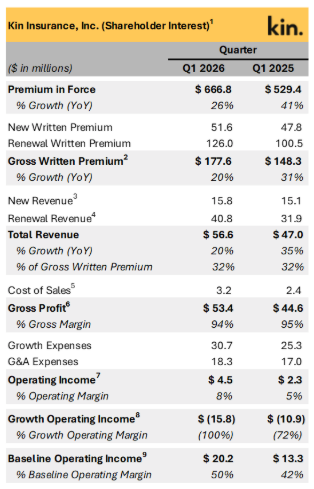
Kin opened 2026 with strong profitability momentum, reporting Total Revenue of $56.6 million and a record Q1 Baseline Operating Margin of 50% — up from 42% in the prior year period. Baseline Operating Income reached $20.2 million, up 37% year-over-year, while Operating Income7 grew 96% to $4.5 million, reflecting the expanding earnings power of Kin's growing renewal base. Gross Written Premium2 reached $177.6 million, a 20% year-over-year increase, with Gross Profit Margin6 remaining strong at 94%. The results reflect growing customer demand for Kin’s expanding suite of home insurance, auto insurance, and home finance products.
“Insurance and reinsurance rates are now stabilized after a period of turmoil between 2022 and 2024. That means fewer customers are shopping, which makes customer acquisition more expensive for us,” said Kin Founder and CEO Sean Harper. “This quarter we spent about $30M on growth expenses and acquired about $16M of new annual recurring revenue (ARR). That means our customer acquisition this quarter will break even at the first renewal, about a year from now. That’s a very fast payback for ARR that has about a 10% net churn rate.”
“Our Baseline Operating Margin reached 50%, or $20.2M, so we were able to cover our growth expenses organically and still nearly double our overall Operating Margin,” said Kin CFO Jerry Fadden. "Since our infrastructure is driven by our investments in software and AI, our general and administrative (G&A) costs are mostly fixed. Small increases in Baseline or G&A expenses were led by investments to further expand our competitive moat.”
“Our technology continues to create market-beating results for the reciprocal exchanges we manage. You can see that in this quarter’s loss results — which continue to outperform target — and in the pricing of our recent catastrophe bond, which priced 300 bps better than the market10,” said Kin Chief Insurance Officer Angel Conlin. “The reciprocals are acting as they should, providing stable capacity to Kin and our customers. There's a natural hedge in our business. When the market environment drives higher acquisition costs, it simultaneously helps the reciprocals increase income, improving their resilience against future volatility.”
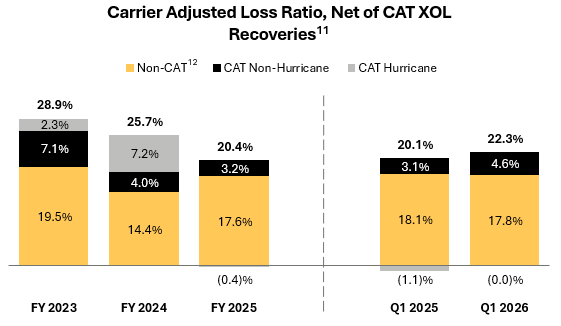
“In the first quarter, non-catastrophe adjusted loss ratios were consistent with the prior year, reflecting strong underwriting performance,” said Conlin. “While Q1 was impacted by winter storms, the performance was in line with expectations. Loss ratios at both reciprocals remained within the range we target for balanced performance.”
Looking ahead, Kin sees significant opportunity to deepen its homeowner relationships across products and geographies. Kin’s two newest services — auto insurance and home financing, both launched in 2025 — are early in their growth trajectories. Kin expects continued momentum as marketing efficiency improves, and the opportunity to bundle home and auto insurance drives higher overall sales conversion and increased auto attachment rates.
“Our strategy is centered on homeowners,” said Harper. “Insurance and financing are deeply connected decisions, especially in the catastrophe-exposed markets we serve. Customers are increasingly looking for simplicity, transparency, and a provider that understands those markets well. Kin is uniquely positioned to deliver that, and we’re seeing more customers choose us across multiple products — home, auto, and home financing."
Kin operates in 14 states — Alabama, Arizona, California, Colorado, Florida, Georgia, Louisiana, Mississippi, Missouri, Oklahoma, South Carolina, Tennessee, Texas, and Virginia — which, together, make up 50% of the Total Addressable Market for home insurance. Known for its positive customer experience, Kin earns a 4.7 out of 5 rating on Google based on more than 8,631 customer reviews, an A+ and 4.8 out of 5 rating with the Better Business Bureau based on 1,479 customer reviews, and an "Excellent" rating of 4.9 out of 5 on Trustpilot.com based on 7,432 customer reviews (as of May 12, 2026).
Kin provides solutions to homeowners to help them save money, simplify tasks, and protect their most valuable assets. By offering direct-to-consumer digital home and auto insurance alongside home finance services, the company focuses on supporting underserved homeowners in states with high catastrophic risk. Kin provides more convenient and affordable home and auto insurance coverage by eliminating the need for external agents and analyzing thousands of data points to provide transparent, accurate pricing. Kin complements this with home financing with Kin-exclusive rates to help homeowners secure a better mortgage rate, refinance, or tap into their equity. Kin’s AI-native technology platform delivers a seamless customer experience, customized options, and fast, high-quality service. To learn more, visit kin.com.
Ally Forsell
1. The financial information represents the GAAP consolidated results of Kin Insurance, Inc., excluding its variable interest entities (VIEs), which include its reciprocal insurance carriers and captive. Prior period results reflect immaterial audit adjustments from prior presentations. Quarterly results are unaudited.
2. Gross Written Premium includes premiums written by the two reciprocals managed by Kin Insurance, Inc. and certain third-party carriers.
3. New Revenue is a non-GAAP measure defined as fee revenue calculated in proportion to New Written Premium as a percentage of Total Written Premium at Kin’s managed reciprocal exchanges.
4. Renewal Revenue is a non-GAAP measure defined as fee revenue calculated in proportion to Renewal Written Premium as a percentage of Total Written Premium at Kin’s managed reciprocal exchanges.
5. Cost of Sales is a non-GAAP measure defined as customer servicing costs and internal claims labor expenses.
6. Gross Profit is a non-GAAP measure defined as Total Revenue less customer servicing costs and internal claims labor expenses.
7. Operating Income is a non-GAAP measure defined as net income/loss attributable to Kin Insurance, Inc., excluding interest expense, income tax expense, depreciation, amortization, stock-based compensation, and other non-operating expenses.
8. Growth Operating Income is a non-GAAP measure defined as New Revenue minus the portion of Cost of Sales attributable to New Revenue and Growth Expenses; Growth Expenses include sales and marketing expenses, variable data costs, and other expenses associated with customer acquisition.
9. Baseline Operating Income is a non-GAAP measure defined as Renewal Revenue minus the portion of Cost of Sales attributable to Renewal Revenue and G&A Expenses; G&A Expenses is defined as operating expenses not associated with customer acquisition.
10. Source: HCMA Database, as of April 15, 2026.
11. The adjusted loss ratio is a non-GAAP measure defined as loss and loss adjustment expenses, net of catastrophe excess of loss reinsurance recoverables divided by earned premium and the earned portion of subscriber surplus contributions during the period and excludes claims management fees paid to the reciprocal exchange’s attorney-in-fact. Any minor differences compared to previously reported data are due to new access to more granular data.
12. The non-cat adjusted loss ratio is a non-GAAP measure defined as total loss and loss adjustment expenses, excluding loss and loss adjustment expenses from named storms and Property Claim Services (PCS) events as defined by Insurance Services Office, Inc. (ISO) divided by earned premiums and the earned portion of subscriber surplus contributions during the period and excludes claims management fees paid to the reciprocal exchange’s attorney-in-fact. Any minor differences compared to previously reported data are due to new access to more granular data.