





Home insurance relies on a predictable balance of risk, but that balance is shifting rapidly across the Lone Star State amid mounting environmental concerns. It’s a change many homeowners are already feeling firsthand.
According to a new survey by Kin Insurance, 37% say they struggled to find a Texas home insurance provider willing to cover their home, and 13% say they received a nonrenewal notice in the past two years.
The shrinking availability of home coverage in Texas reflects the impact of increasingly severe, more frequent weather events in the state. From tornadoes and hurricanes to droughts and cold waves, these disasters have caused billions of dollars of damage in recent years. As insurance costs rise alongside other living expenses, some homeowners are caught in a difficult position — unable to afford the very upgrades that could make their homes easier to insure.
"It's a tough reality for Texans right now. Severe weather events are becoming more frequent, yet the cost of hardening a home against these risks can feel like a barrier for many families. The good news is that protecting a home doesn't always require a major investment," says Angel Conlin, Chief Insurance & Compliance Officer at Kin Insurance.
"Installing roof clips (small metal brackets that secure your roof during a storm) can run as low as $800 to $2,500 for a typical home, depending on the home's size and roof type, and they can pay for themselves over time through lower insurance premiums. Consistent, low-cost maintenance like this is one of the most effective things homeowners can do to stay resilient and protect their access to the coverage they need."
Key takeaways
-
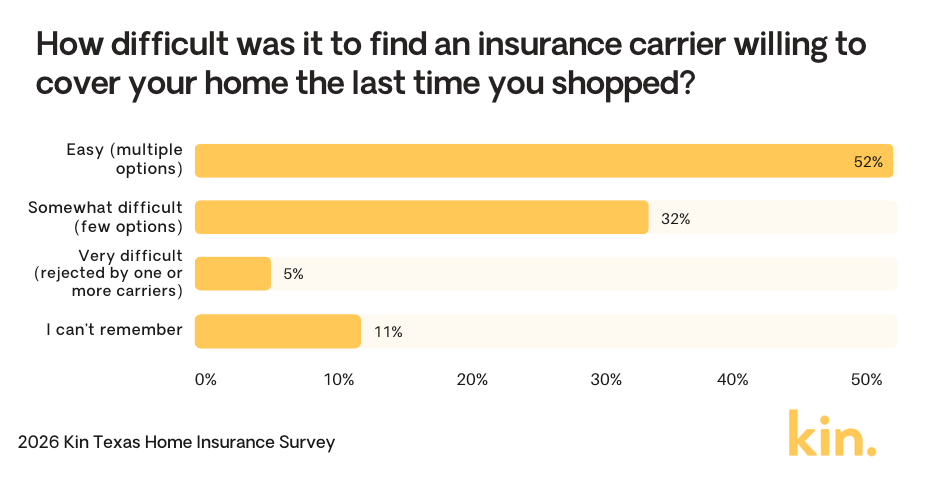
37% of Texas homeowners say it was “somewhat” or “very” difficult to find an insurance company willing to cover their homes.
-
52% say it was easy (multiple options).
-
32% say it was somewhat difficult (few options).
-
5% say it was very difficult (rejected by one or more carriers).
-
11% say they can’t remember.
-
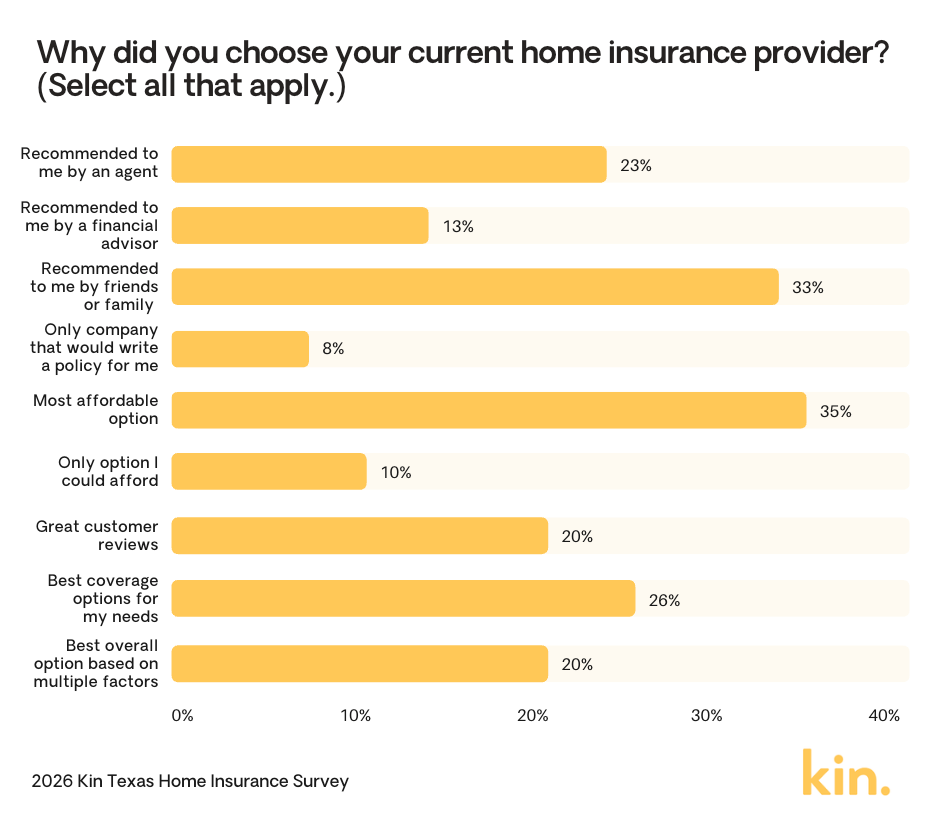
35% of Texas homeowners say they chose their home insurance company because “it was the most affordable option.”
-
33% say a friend or family member recommended it.
-
26% say it had the best coverage options for their needs.
-
10% say it was the only option they could afford.
-
8% say it was the only company that would write a policy for them.
-
26% of Texas homeowners have either received a nonrenewal notice for their home insurance in the last two years or have a friend/neighbor in Texas who has. (Note: A nonrenewal notice occurs when your insurance company chooses not to renew your policy after it expires.)
-
13% have personally received a nonrenewal notice.
-
13% have a friend/neighbor in Texas who has received a nonrenewal notice.
-
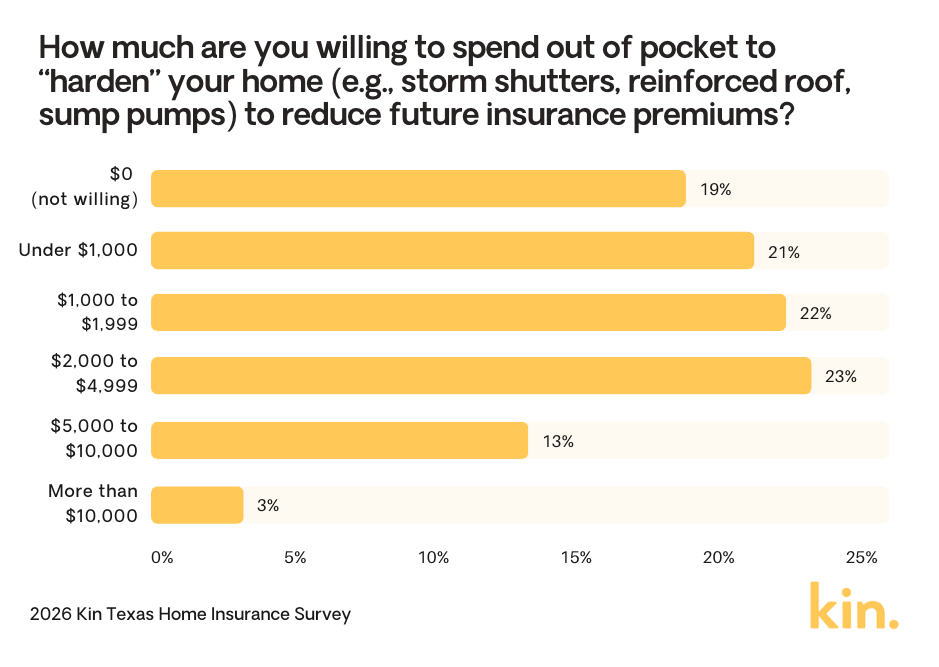
19% of Texas homeowners aren’t willing to spend any money on hardening their homes against damage from natural disasters and extreme weather — which could help them secure better, more affordable home insurance coverage.
-
21% say they’d be willing to spend up to $1,000 on home-hardening measures.
-
17% say they’d be willing to spend $5,000 or more.
-
38% of Texas homeowners say convective storms (tornadoes, hail, and wind) are the weather event they’re most concerned will damage their homes in the next five years.
-
24% are most concerned about tropical cyclones (hurricanes, tropical storms, and storm surge).
-
15% are most concerned about severe winter weather, including ice storms, heavy snow, and freezing pipes.
-
12% are most concerned about inland flooding (including heavy rain, river overflow, or flash floods not caused by hurricanes).
-
37% of Texas homeowners lost food to spoilage due to power outages during Hurricane Beryl.
-
12% filed home insurance claims to cover the spoiled food.
-
24% lost food to spoilage but didn’t file a claim.
Note: Sub-figures may not sum to totals due to rounding.
More than 1 in 4 Texas homeowners received a nonrenewal notice or know someone who has
This shifting landscape is becoming a common reality across the Lone Star State. Whether it is a notice arriving in their own mailbox (13%) or a neighbor sharing the news (13%), approximately 26% of Texans now have a personal connection to these insurance changes. Nonrenewal notices typically indicate that an insurer has decided to limit their exposure in a certain area, often due to an increase in regional risk since the policy was first opened.
The change is a response to a string of record-breaking years for the industry. In 2024 alone — a year marked by spring wildfires and Hurricane Beryl — home insurance losses in Texas topped $10 billion. Given the scale of these catastrophic losses, some major insurers have paused or reduced their business in the state, making the market significantly tighter for everyone.
As a result, the search for a new policy is becoming a hurdle for a growing number of residents. While 52% of Texas homeowners still say finding home insurance was “easy,” a significant 37% now find it somewhat or very difficult to secure coverage. Within that group, 5% of homeowners report being rejected by one or more insurers.
More Texas homeowners prioritize affordability than coverage options
As market conditions tighten in Texas, homeowners are pushing affordability and accessibility to the top of their priority list when shopping for home insurance, either for the first time, to save money, or to find new coverage after a nonrenewal.
Only 26% of homeowners say they chose their home insurance company because it had the best coverage options, while 35% say they simply chose the most affordable option. For almost one in five homeowners, choosing home insurance was easy: 10% say their home insurance company was the only one they could afford, and 8% say it was the only company willing to insure their home.
19% of Texas homeowners aren’t willing to spend any money to harden their homes against weather damage
Texas homeowners aren’t blind to the risks that climate change is bringing to the state. When asked to rank the weather events they’re most concerned will damage their homes in the next five years, 38% of Texas homeowners point to convective storms, followed by tropical cyclones (24%), winter weather (15%), and inland flooding (12%).
Yet nearly one in five homeowners (19%) say they’re not willing to spend any money to harden their homes — the process of using stronger building materials to help a house stand up to threats like high winds and flying debris. In total, 61% are unwilling to spend $2,000 or more on these measures.
This trend isn’t necessarily a matter of homeowners overlooking the risks of severe weather. Rather, it often comes down to financial feasibility. According to the Federal Reserve, only 48% of adults in the U.S. could cover an emergency expense of $2,000 or more using only their savings. With household budgets stretched tight by routine expenses — including the rising cost of home insurance — many Texans find that the high cost of home fortification is simply out of reach.
However, there are several low-cost ways homeowners can improve their home’s defense against the elements and appeal to insurers.
Home hardening tips for Texas homeowners
If a major renovation isn’t in the budget, focus on these manageable, high-impact steps.
| Weather threat | Low-cost precautions | Bigger investments |
| Convective storm (e.g., tornado, thunderstorm) |
|
|
| Hurricane or tropical storm |
|
|
| Winter weather |
|
|
| Inland flood |
|
|
Methodology
Kin commissioned Pollfish to poll a nationally representative sample of 1,000 American adults between the ages of 18 and 65 who currently own a single-family home in Texas. (For the purposes of this survey, apartments, condos, mobile, and manufactured homes did not qualify as single-family homes.) The survey was performed online on February 16, 2026. Percentages were rounded to the nearest whole number.
