





Kin’s Midyear Homeownership Report brings you data-driven insights on the state of American homeownership. We surveyed 1,000 homeowners to see how sentiment has shifted since our January 2026 Homeownership Trends Report and what the first half of the year has actually looked like.
Executive summary
In late 2025, we asked homeowners questions about affordability, accessibility, and climate concerns. Six months later, the picture that emerged is one of mounting pressure.
Homeownership expenses and mortgage rates have both risen, climate anxiety remains high, and the home insurance market continues to present challenges for homeowners — through rising costs, nonrenewals, and insurers pulling back from high-risk areas. As of May, 37% of homeowners aren't confident they can maintain adequate home insurance coverage through the end of 2026, up from 31% in December 2025.
For many, relief feels out of reach. But Kin CEO Sean Harper and other experts believe the second half of the year could bring some breathing room — if conditions cooperate.
Key takeaways
-
Premium hike expectations have intensified.
-
In December, 45% of homeowners predicted a home insurance premium hike of 6% or more in 2026. As of May, 48% expect a 6%+ increase in their policy cost.
-
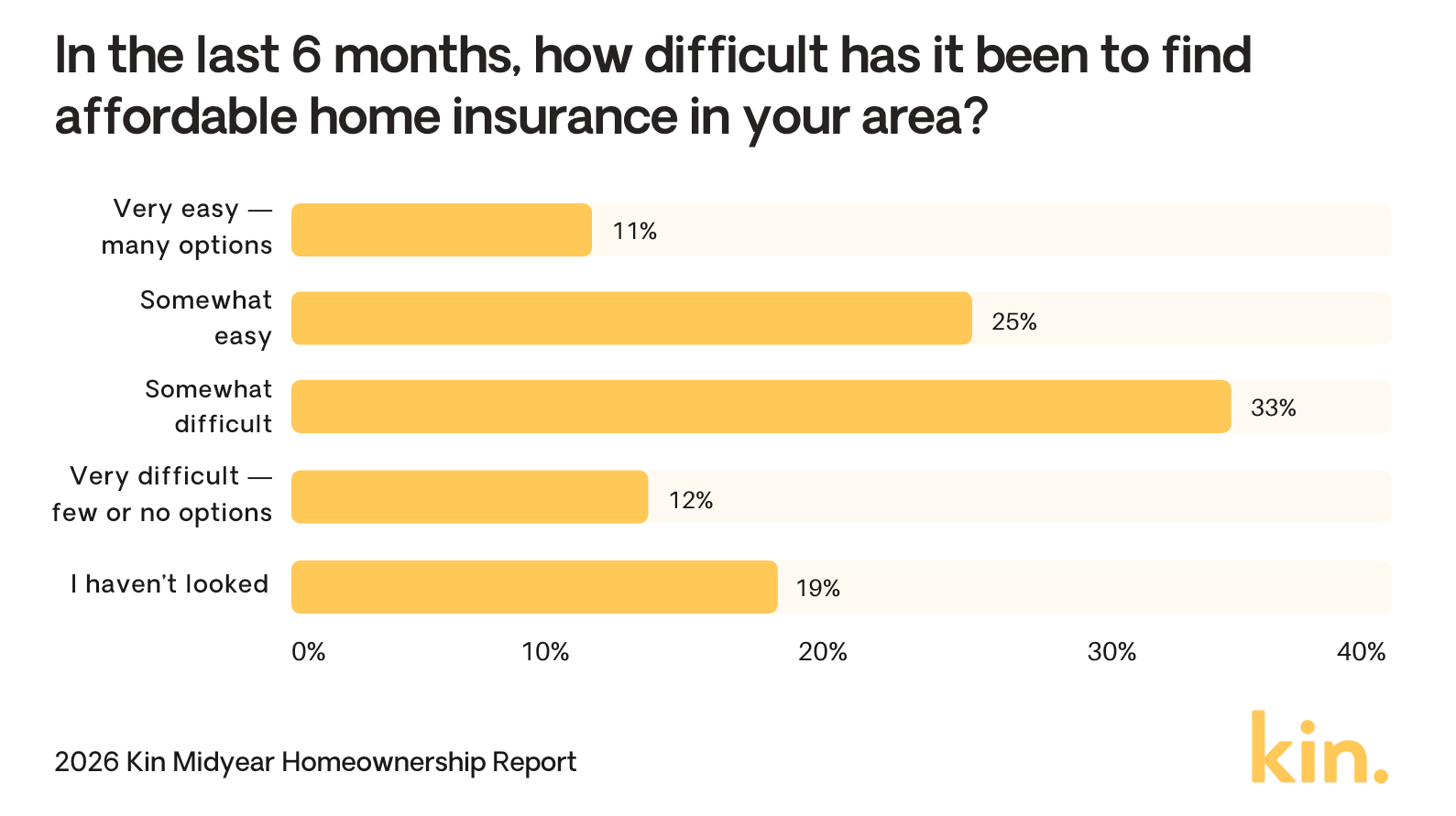
Nearly half (45%) of homeowners say it was difficult to find affordable home insurance in their area in the last 6 months — 12% report it was “very difficult” with few or no options and 33% say it was “somewhat difficult.”
-
-
Uncertainty about staying insured is growing.
-
2 in 5 homeowners (40%) say their policy or someone they know was nonrenewed or dropped in the last 12 months.
-
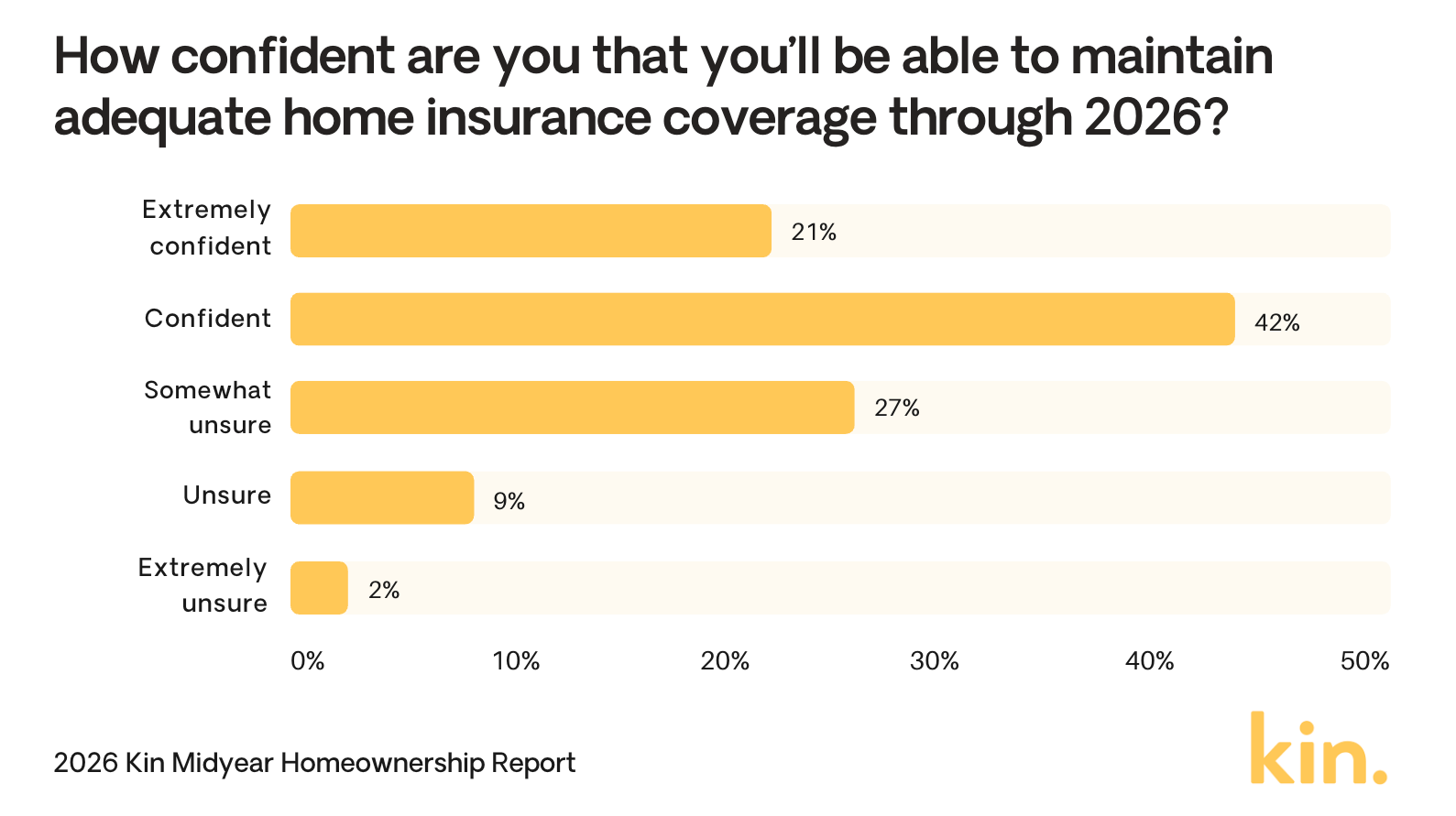
37% of homeowners aren’t confident they can maintain home insurance coverage in 2026.
-
-
Home prices and repair costs are causing concern.
-
56% of homeowners say high home prices would be their single biggest concern if buying or selling in the next 6 months, above mortgage rates and climate risk.
-
64% of homeowners say the cost of home repair and improvement materials has gone up in 2026, a rise that 80% of homeowners predicted back in December.
-
-
Optimism about interest rate relief has eroded.
-
In December, 32% of homeowners believed interest rates would drop in 2026. But as of June 2026, 30-year mortgage rates are actually higher on average than they were 6 months ago (6.48% vs. 6.19% in December 2025).
-
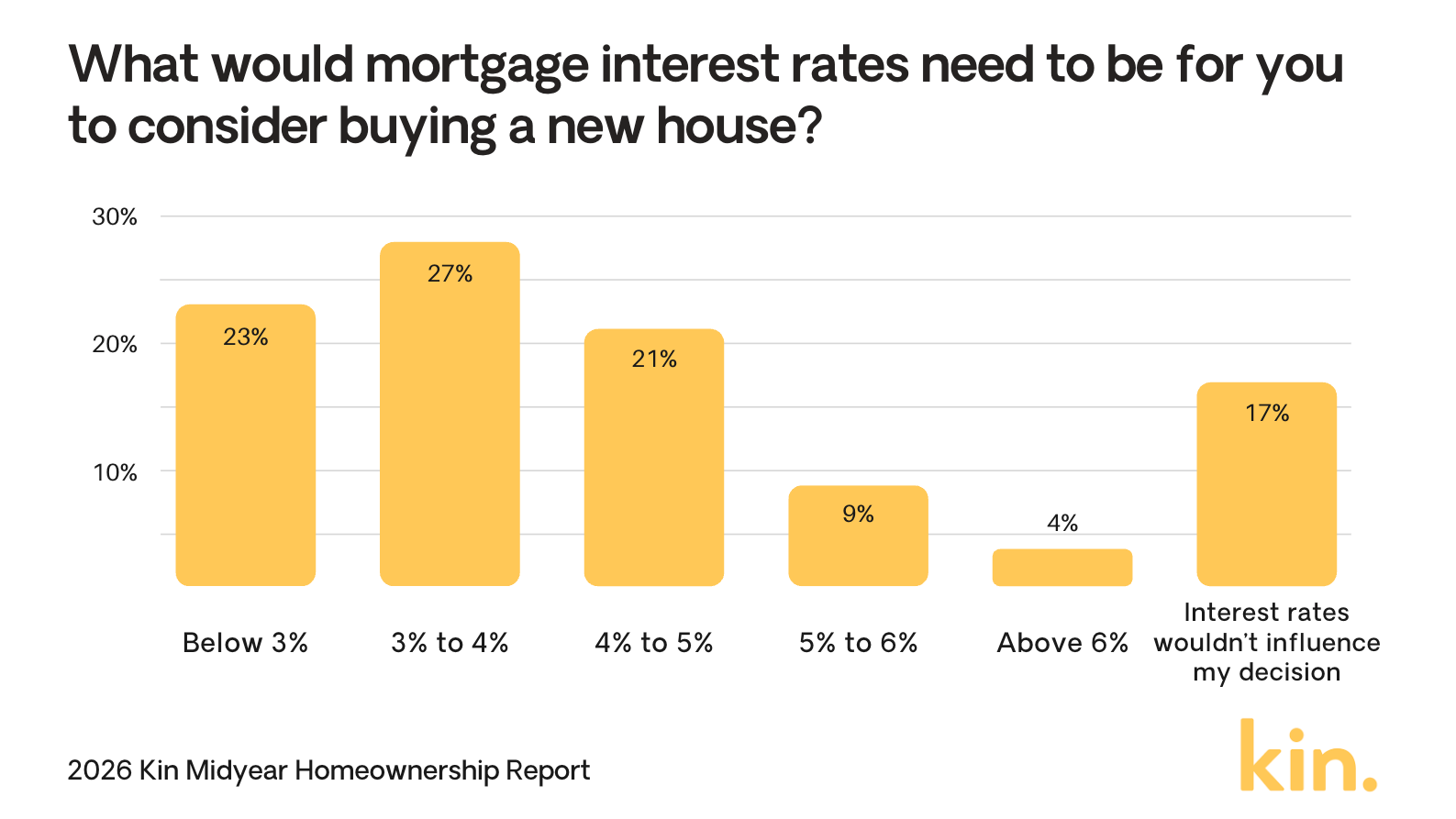
50% of homeowners now say they’d need rates at or below 4% — levels not seen since 2021 — before they’d consider buying a new home.
-
-
Homeowners remain underprepared for extreme weather.
-
Nearly half (46%) of homeowners have not taken any steps to protect or fortify their home against weather or natural disaster damage in the last year.
-
Among homeowners who live in hurricane-affected areas, nearly 1 in 4 (24%) feel not very or not at all prepared for the 2026 Atlantic hurricane season, which officially began June 1.
-
Only 6% of homeowners purchased additional flood or hurricane coverage, even though damage from rising water or storm surge is excluded by default from standard home insurance policies.
-
Note: Sub-figures may not sum to totals due to rounding.
The insurance market: Harder to navigate, harder to afford
Six months in, the home insurance market remains one of the biggest pressure points for American homeowners in 2026. Our midyear data suggest the strain is across availability, costs, and consumer confidence.
Finding affordable coverage is still a challenge in much of the country
Nationwide, 45% of homeowners say they've found it difficult to find affordable insurance in the last six months. A related measure suggests the trend is worsening. The share of homeowners uncertain about maintaining coverage at all has grown from 31% to 37% between December and May.
That strain isn't spread evenly. Fewer Texas homeowners, for instance, say they’ve struggled to find affordable insurance, with over 50% saying it was “easy” to find coverage at a good price. On the other hand, in California 60% of homeowners have struggled to find affordable home insurance in the past three years, and 1 in 3 are “very concerned” that home insurance companies will no longer operate in the state.
“What’s worse than expensive insurance? No insurance. And that's what started to happen to some California homeowners that were dropped or nonrenewed. California insurance prices had been too low for too long. Insurance prices were effectively capped and fewer insurers were willing to sell policies,” says Kin CEO Sean Harper.
“The market needed to be reset and it was. Pricing has gone up, but Californians can now find the coverage they need and insurers feel more comfortable doing business. For homeowners who have hardened their home and reduced risk, lower-cost policies are still available. That’s one of the reasons Kin prices policies by individual home features, so customers making smart choices are rewarded.”
The availability problem extends beyond state lines. Forty percent of U.S. homeowners have been personally touched by a nonrenewal or cancellation — 8.5% had their own policy dropped, 22% know someone who did, and 9.5% experienced both.
"That's a pretty alarming statistic,” says Kin Chief Insurance & Compliance Officer Angel Conlin. "The risk map has changed. Areas that were once considered low-risk are generating the kinds of catastrophic losses that, not long ago, were concentrated in a handful of high-exposure markets.”
For homeowners who receive a nonrenewal notice, Conlin's advice is straightforward: "If you get a nonrenewal notice, your immediate move should be to start looking for a new insurer. Don't wait until the last minute, because finding coverage takes more work than it used to. But I wouldn't feel defeated — there should be options available. It's just going to require more effort to find insurers to cover homes in more catastrophe-prone areas.”
Premium expectations have shifted toward steeper increases
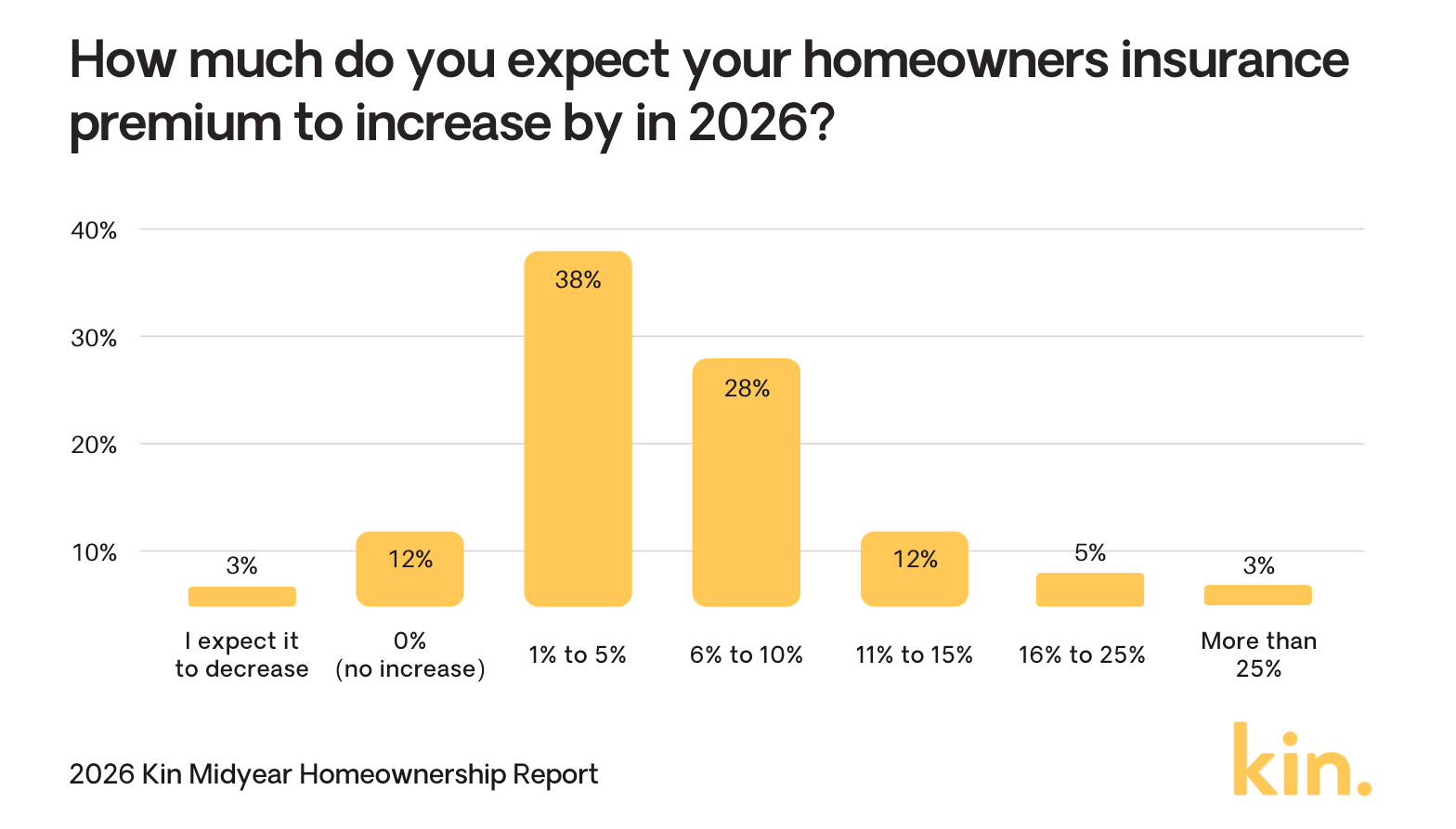
In December 2025, nearly 9 in 10 homeowners (88%) expected their home insurance premiums to increase in 2026, with 45% predicting an increase of 6% or more. As of May, only slightly fewer (86%) say they expect their premium to go up — and among those anticipating increases, expectations now trend toward steeper hikes.
While 43% of homeowners predicted premium increases between 1% and 5% in December, that number has shrunk to just 38%. Meanwhile, 20% predict an increase of 11% or more, compared with just 16% six months ago. Data to see what actually happened with 2026 home insurance premiums won’t be available until 2027, but these consumer perceptions paint a picture of homeowners' concern for continued price hikes.
Confidence in maintaining coverage is eroding
A growing number of homeowners aren’t sure they’ll be able to maintain their home insurance coverage. In December, only 31% of homeowners expressed some level of uncertainty that they’d be able to maintain adequate coverage; today, that number is 37%.
More than 2 in 5 homeowners are shopping around or planning to switch
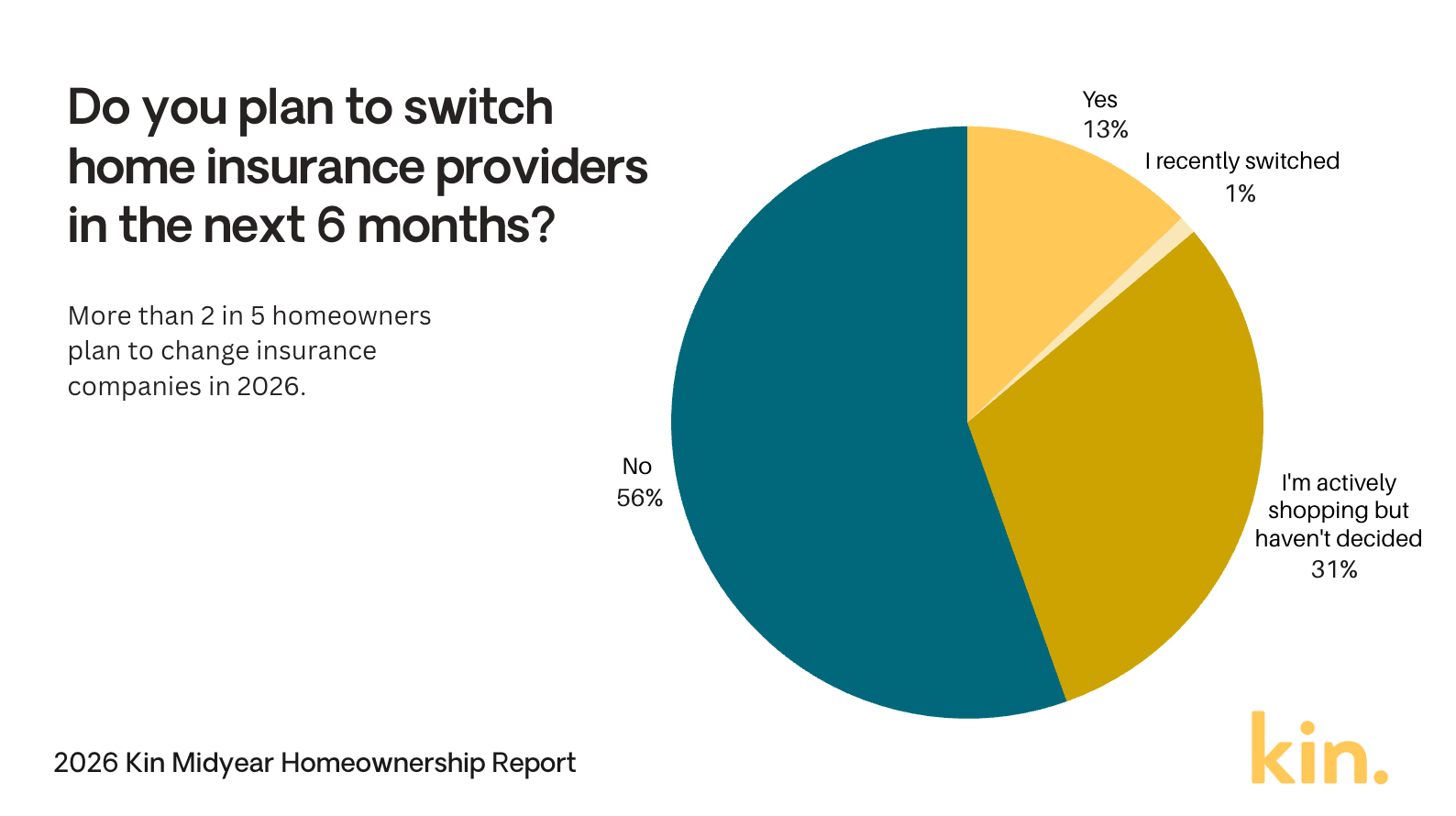
In light of the challenging home insurance market, more than 2 in 5 homeowners (43%) are considering switching to a new insurance company. Approximately 31% are actively shopping but haven’t settled on a new carrier yet, and almost 13% say they plan to switch within the next six months.
"Customers should be looking for carrier partners who are willing to help them find the exact right amount of coverage rather than forcing unnecessary coverage,” says Conlin. “A lot of carriers set standard minimums — say, personal property coverage at 50% of your home value, when most people don't actually have that much stuff. Flexibility matters."
Homeowners are also considering the cost of insurance as a key component of home purchase decisions. In December 2025, 70% said home insurance costs weighed more heavily in their decision to buy a home than it did five years ago. Today, 64% say that insurance prices moderately, seriously, or very heavily weigh on their home purchase decisions.
The locked-in homeowner: Still stuck, still waiting
For many homeowners, the feeling of being stuck starts with mortgage rates. The gap between where rates are and where homeowners need them to be has only widened.
Waiting on rates that may never come
In December 2025, 32% of homeowners believed that interest rates would meaningfully drop in 2026, with 46% saying they’d need to see interest rates at 4% or below to consider buying a new house.
But as of early June 2026, Freddie Mac data show the opposite: 30-year mortgage rates are actually higher on average now (at 6.48%) than they were six months ago (6.19% as of mid-December 2025).
With interest rates mostly stagnant and even climbing, fewer homeowners are willing to budge on what it would take to get them back into the market. In May 2026, half of those surveyed (50%) say they'd need rates at or below 4% — levels not seen since 2021.
For a small percentage of homeowners, though, resignation to a high rate environment may be setting in. Seventeen percent now say interest rates would not affect their homebuying decisions, up from 13% in December.
Mortgage rate stagnation isn't the only cost weighing on homeowners. As of May 2026, 39% say managing costs like insurance, repairs, and home improvement is harder now than it was six months ago — an increase of 8 percentage points from December 2025.
Tariffs and global economic uncertainty are making things worse
More than 2 in 3 homeowners (67%) say global economic conditions, including tariffs, supply chain disruptions, or geopolitical uncertainty, have affected their home improvement or repair plans.
It’s not just DIY projects being put on hold. An additional 34% of homeowners say these same conditions have changed their decision to move or stay in their current home.
Home prices: Rising, falling, and everything in between
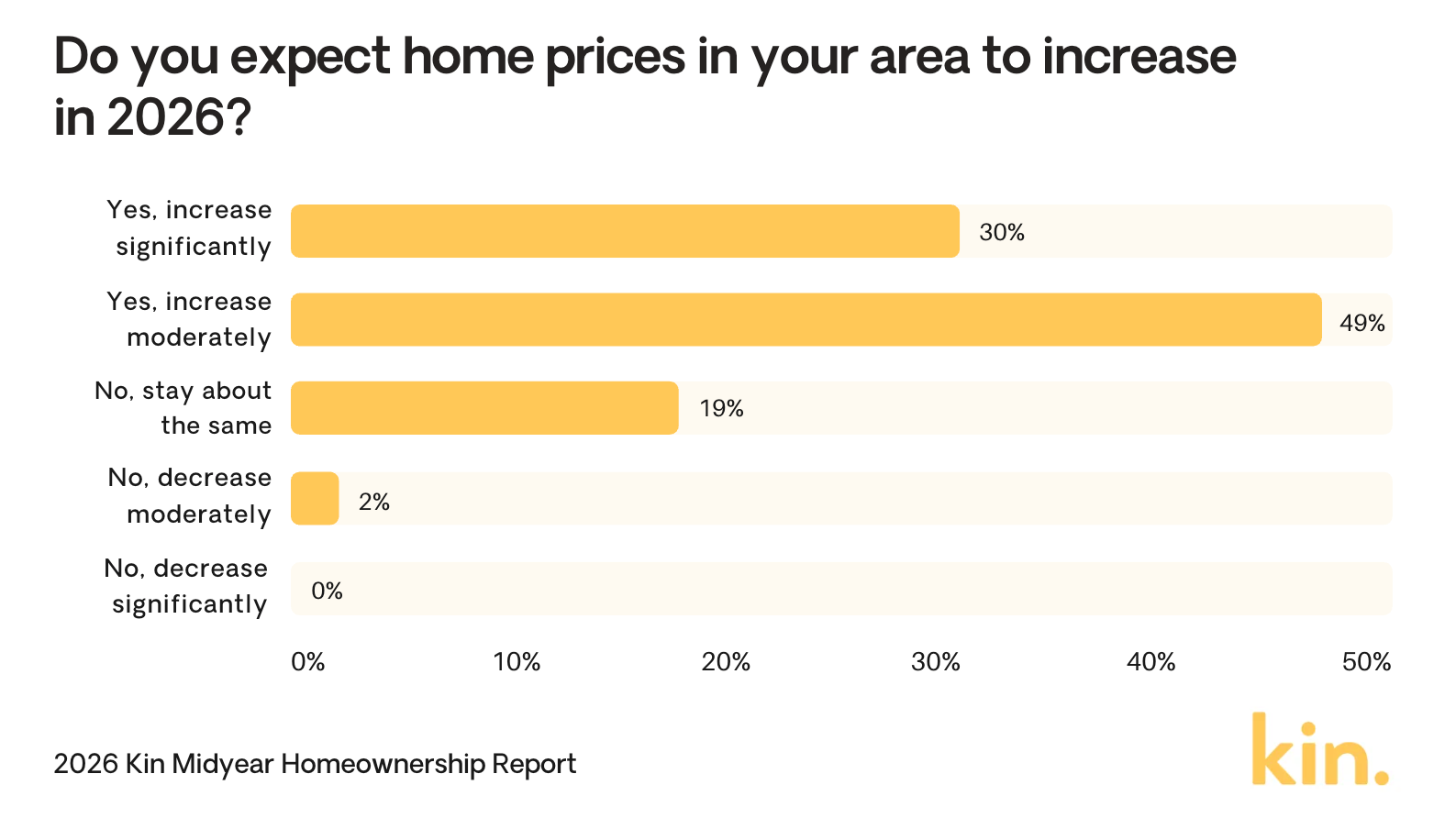
Homeowner sentiment on prices hasn't budged much — 79% still expect prices in their area to rise, essentially unchanged from December. But the underlying data point in different directions.
The May existing-home sales report from the National Association of Realtors shows the national median sale price rose 1.3% year over year to $429,300 — the 35th consecutive month of increases. At the same time, the May housing report from Realtor.com shows median list prices fell 2.4% year over year — the steepest decline since 2017. The difference: sale prices reflect closed transactions, while list prices reflect what sellers are currently asking.
What's less ambiguous is the cost pressure homeowners are feeling regardless of where prices land. Over half (56%) say high prices would be their single biggest concern if buying or selling in the next six months, while just 22% cite mortgage rates. And even for those not planning a transaction, repair and maintenance costs are climbing. In December, 80% predicted that those costs would rise in 2026, and today 64% report they already have, with 20% saying significantly and 44% saying somewhat.
Climate anxiety has softened — but it hasn't gone away
Six months ago, 9 in 10 homeowners said they were concerned about damage to their home from a changing climate. That number has edged down since December, though the concern hasn't disappeared — particularly in high-risk states like Hawaii, Florida, and California.
Fewer homeowners are considering a climate-driven move than 6 months ago
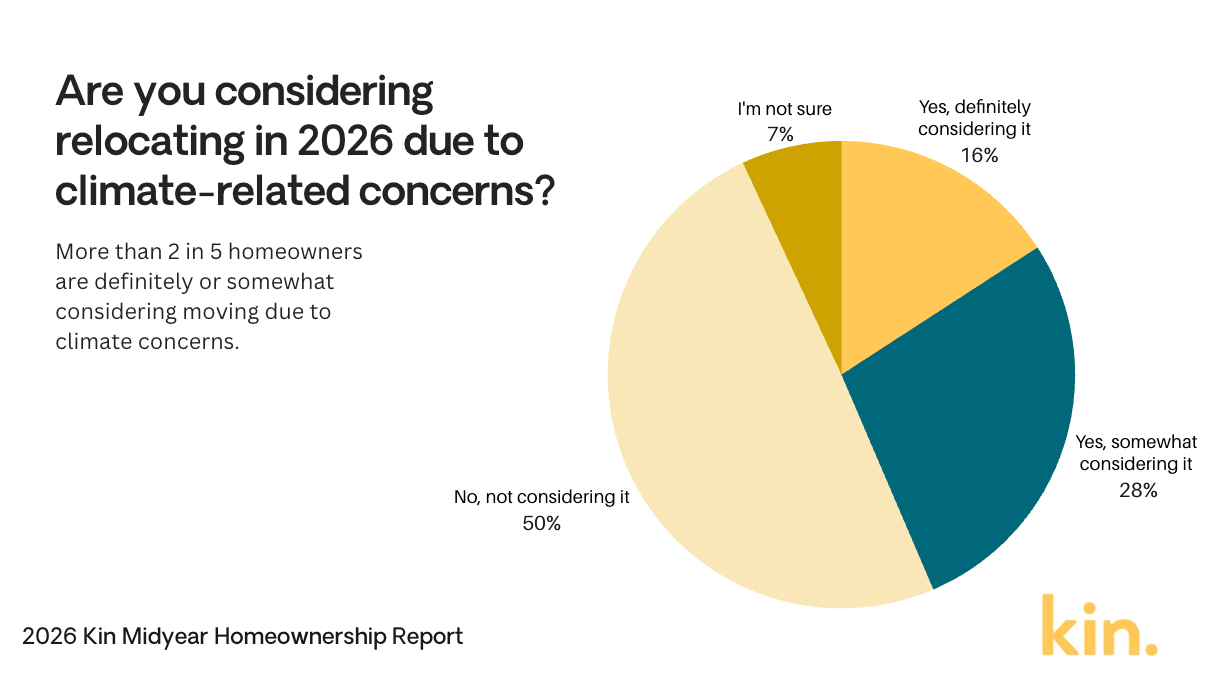
In December, nearly half (49%) of homeowners said they were considering moving in 2026 due to climate-related concerns. Six months later, fewer homeowners are considering such significant changes — but climate migration remains on the table for many. As of May 2026, 16% of homeowners say they are “definitely” considering moving due to climate concerns, and 28% say they are “somewhat” considering such a move.
This shift may partly reflect the relatively calm 2025 hurricane season, which produced fewer billion-dollar disasters than either of the two prior years. How homeowners perceive risk tends to track recent experience more than long-term trends.
"The longer you go without a major storm, the more that urgency fades — in preparation, in public memory. Two quiet seasons are good for rebuilding. They're less good for keeping preparedness top of mind," says Kin Vice President of Claims Justin Wetmore.
"There's no true climate haven. No matter which area of the country you look at, you're going to find risks with higher frequency or severity. The question is whether homeowners understand the specific risks where they live," adds Conlin.
Homeowners are still protecting themselves — but many feel underprepared
Whether or not they’re considering a move, many homeowners are taking steps to protect their current homes from climate risks as long as they’re in them. Over half (55%) of homeowners say they took at least one home-hardening step last year, including structural improvements (22%) and clearing vegetation/debris (13%). A small percentage (6%) say they’ve added flood or hurricane coverage to their home insurance policy, while 13% of homeowners say they’ve taken multiple steps to prepare for climate damage.
But more than a third (37%) of homeowners have taken no steps to protect or fortify their homes against natural disasters or extreme weather — and don’t plan to. An additional 9% say they plan to undertake such measures but haven’t yet.
"The key is figuring out how we as an industry can bring education to customers in each area — what are the risks they should be most wary of, and what can they do to harden their home against them. A lot of the accessibility and affordability challenges in insurance can be mitigated by that home hardening," says Conlin.
Lack of preparedness may be most felt in regions prone to tropical storms and hurricanes. The 2026 Atlantic hurricane season officially began on June 1, and 24% of homeowners in hurricane-affected areas say they feel “not very” or “not at all” prepared.
"NOAA and Colorado State University are projecting a slightly below-average year — eight to 14 named storms, three to six becoming hurricanes, one to three being major. But fewer hurricanes doesn't mean safer. El Niño actually carries some of the same dangerous factors that drive a busy season, like elevated ocean temperatures. So while you may see fewer hurricanes, you can also see elevated risk in nearly every other weather peril — and to more extreme degrees," says Wetmore.
What H2 2026 holds: Conclusions & predictions
As we enter the second half of 2026, our expectations for the insurance and housing markets have shifted, but climate remains a central focus for experts and homeowners alike. In the first six months of 2026 alone, the U.S. weathered five separate billion-dollar climate disasters, from winter storms in the Northeast to tornado outbreaks across central and southeastern states.
The data from our midyear survey reflect all of it: a housing market under pressure, an insurance market in transition, and homeowners caught in the middle.
The insurance market should open up — if the macro holds
Despite the strain homeowners are feeling, Conlin says that the second half of 2026 may bring modest relief in some markets.
"I don't anticipate conditions becoming significantly more difficult in the second half of 2026. The market tends to move gradually, so homeowners should expect relative stability — with the possibility of some incremental improvement in select markets," she says.
Materials costs are the wildcard
Where uncertainty remains strong, Harper says, is the cost of home building materials and its downstream effect on insurance.
“The biggest concern I’m hearing is materials costs. If geopolitical instability disrupts oil supplies to Asia (where a huge portion of global manufacturing happens), we could see shortages of goods again — not just higher prices but genuine availability problems. Energy prices haven’t hit the insurance market yet. But if they stay elevated, they will,” adds Harper.
For homeowners, that chain — from geopolitics to oil to manufacturing to building materials to home replacement values — means premiums could face new upward pressure heading into 2027, even if the broader insurance market stabilizes in the near term.
The housing market unlock remains rate-dependent
The locked-in homeowner problem isn’t resolving on its own. Harper frames it in stark terms: “The K-shaped economy is real, and homeowners are on the upper end of it. Home values have appreciated significantly. The people who are struggling are the ones who can’t afford to get in — and that gap is only widening as rates stay elevated.”
“The situation is getting worse, not better, because interest rates are higher,” he adds. “For anyone buying a home right now, my advice is to look at the all-in cost — and that includes insurance. Insurance costs can vary significantly depending on the traits of the home: the roof type, the age of the structure, how close it is to a risk.”
For now, homeowners are navigating all of it at once.
Methodology
Kin commissioned Pollfish to poll a nationally representative sample of 1,000 American adults between the ages of 18 and 65 who currently own a single-family home in the United States. (For the purposes of this survey, apartments, condos, mobile, and manufactured homes did not qualify as single-family homes.) The survey was performed online on May 25, 2026. Percentages were rounded to the nearest whole number.
