





It’s only been 52 years since the Equal Credit Opportunity Act (ECOA) of 1974 made homeownership a possibility for single women through a mortgage.
Prior to the ECOA, lenders usually required single, divorced, or widowed women to have a male co-signer to secure a mortgage — meaning homeownership was limited to married women or to those wealthy enough to pay in cash. Today, there are more than twice as many unmarried women homeowners than unmarried men homeowners: 21% of homebuyers are single women, 9% are single men, and 61% are married couples.
From the first generation of single women homebuyers in the 1970s to Gen Z homeowners today, a survey by Kin Insurance found that many women share some common priorities, expectations, and fears when purchasing a home. While affordability is a leading priority for almost a third of women homeowners surveyed, practical considerations like location also carry significant weight. Once moved in, female homeowners list major costs like property taxes, natural disaster damage, and unexpected repairs among the biggest surprises and challenges of homeownership.
Key takeaways
-
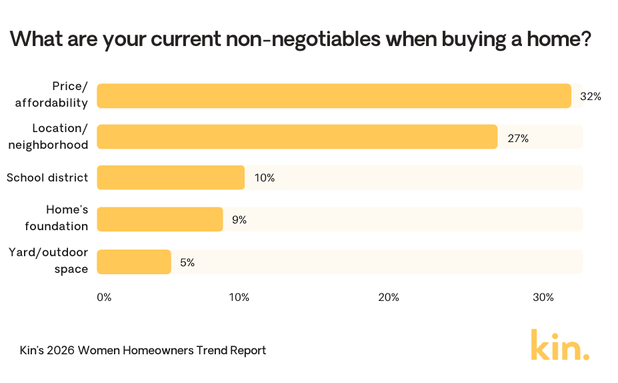
Price isn’t everything: Only 32% of women homeowners named price/affordability as their No. 1 priority when purchasing a home.
-
Other top priorities included location/neighborhood (27%), school district zoning (10%), the condition of the home’s foundation (9%), and the yard/outdoor space (5%).
-
48% say the size of a yard/outdoor space is “much” or “somewhat” more important when purchasing a home today than it was between 2020 and 2022.
-
Function over form: When evaluating a home to purchase, 31% of women homeowners say they prioritize structural elements over cosmetic features.
-
Only 5% of women homeowners prioritize cosmetic features over structural elements.
-
63% prioritize both equally.
-
Are you ready for tax season?: Property tax increases are the only expenses that women homeowners were more likely to list as their biggest surprise compared to homeowners as a whole (49% vs. 46%).
-
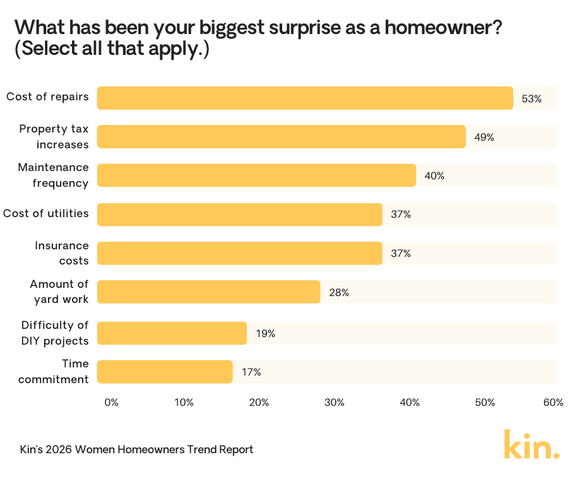
The cost of repairs leads the list of women homeowners’ reality checks, with 53% describing this as their biggest surprise.
-
Other surprises included the frequency of maintenance needs (40%), insurance costs (37%), amount of yard work (28%), and the difficulty of DIY projects (19%).
-
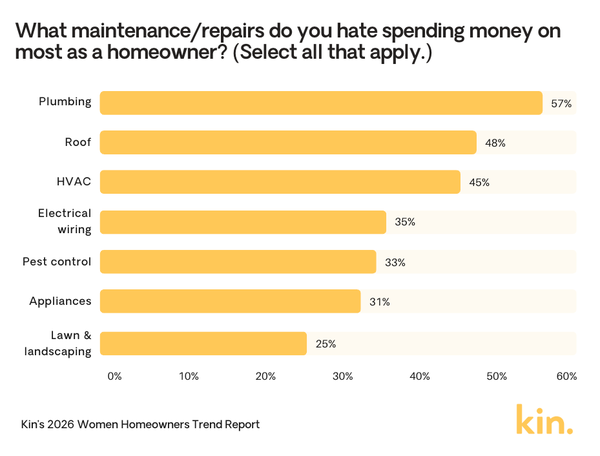
Don’t fear the plumber: 43% of women homeowners say major unexpected repair costs are their greatest fear as a homeowner, and plumbing bills top the list as the maintenance/repair cost they hate spending money on the most (57%).
-
Other dreaded maintenance and repair expenses include roofing (48%), HVAC (45%), electrical (35%), and pest control costs (33%).
-
Second to maintenance costs, 21% of women say natural disaster damage is their top fear.
Two-thirds of women homeowners say price isn’t their No. 1 priority when buying a home
When purchasing a home, more women homeowners selected “price/affordability” than any other single concern. But only 32% of women named it their No. 1 priority. For over two-thirds of respondents (68%), something other than price was their top homebuying priority.
Most women homeowners blend practicality with personality when purchasing a home: 63% say they prioritize structural elements and cosmetic features equally, while just 5% said that cosmetic features were their primary concern.
Many women homeowners’ top priorities, though, have less to do with the structure and aesthetics of the house itself and everything to do with what’s around it — like the neighborhood (27%), the school district (10%), and the yard (5%). These priorities may reflect a difference in how women homeowners think about their purchase: not just as a financial investment or a physical acquisition, but as a place to nurture their families and their futures.
Women homeowners are more prepared for routine costs, but less prepared for property tax increases
We recently asked a group of American homeowners — men and women — to list their biggest surprises as homeowners. Repair costs topped that list, and the same holds true for women homeowners, with 53% citing repair bills as their primary shock.
But women were generally less likely to list most routine homeownership costs as surprising — from maintenance needs (40%) to insurance (37%), utilities (37%), yard work (28%), and DIY projects (19%) — than the general group of men and women.
The sole exception was property tax bills: 49% of women cited them as a major surprise, surpassing the 46% reported by the general homeowner population.
Major unexpected repair bills are women homeowners’ No. 1 nightmare
When it comes to their greatest fears as homeowners, women point to sudden, unexpected costs: major repair bills and natural disaster damage. For female homeowners living in the path of hurricanes, tornadoes, hailstorms, blizzards, or any of the other severe weather events that cost homeowners billions of dollars each year, those top fears go hand in hand.
“Our study found that while women prioritize the 'soul' of a home — its neighborhood and outdoor spaces — they are also deeply practical about its structural health,” says Angel Conlin, Kin’s Chief Insurance & Compliance Officer. “Making sure your home is hardened against extreme weather damage is more important now than ever, and one of the best ways to avoid major repair costs in addition to having adequate home insurance coverage in place."
However, it’s also important to understand what home insurance won’t cover. That includes routine maintenance bills, repairs for regular wear and tear, and costs associated with flood damage (unless you supplement your home insurance policy with flood insurance).
How women homeowners can minimize risk and protect their finances
Women’s homebuying priorities and ownership challenges focus on both subjective and practical concerns: How much house can I afford? Where will my kids go to school? Where will we be happiest? And what if I can’t pay for repairs after the next big storm?
While unexpected bills are an inevitable part of homeownership, women can take proactive measures to mitigate risk and prepare for potential surprise expenses down the road. Here’s how:
-
Stay on top of home maintenance: Not only can maintenance catch small issues, like a rusting pipe, before they become big emergency repair bills, there’s another hidden benefit. Home insurance won’t cover damage caused by neglect or poor maintenance — so tending to your home’s needs on a regular basis could save you money twice over.
-
Look for low-cost, high-impact home upgrades: Kin’s survey shows that women homeowners care more about their home’s structural integrity than its appearance, so prioritize practical DIYs like installing smart leak detectors or a monitored alarm system.
-
Build your credit: Your credit history might seem disconnected from homeownership costs, but it’s not — it’s actually one of the top drivers of high home insurance rates.
-
Review your insurance policies regularly: Make time annually or biannually to look over your home insurance and any supplemental coverage, such as a flood or umbrella insurance policy. Is your coverage still meeting your needs? Are you comfortable with how much you’re paying?
-
Increase your insurance savvy: Understanding what home insurance does and doesn’t cover, how to file a home insurance claim, and how to build and maintain a detailed home inventory can help you streamline the claims process, maximize your payout, and lower out-of-pocket costs if you ever do need to rely on your coverage after a major loss.
Methodology
Kin commissioned Pollfish to poll a nationally representative sample of 445 American women between the ages of 18 and 65 who currently own a single-family home in the United States. (For the purposes of this survey, apartments, condos, mobile, and manufactured homes did not qualify as single-family homes.) The survey was performed online on November 4, 2025. Percentages were rounded to the nearest whole number.
