





A mobile home’s serial number is a unique code that holds key information about the home. Sometimes called a vehicle identification number (VIN), you’ll be asked to provide your mobile or manufactured home’s serial number when financing or selling your home, making significant structural improvements, or purchasing mobile home insurance.
Think of your mobile home’s VIN as its DNA. This distinct string of numbers and letters holds important information about the dwelling, including which company manufactured it and where it was built.
If you can’t find the VIN, don’t sweat it. You can look up your mobile home serial number a few different ways.
What is a mobile home serial number?
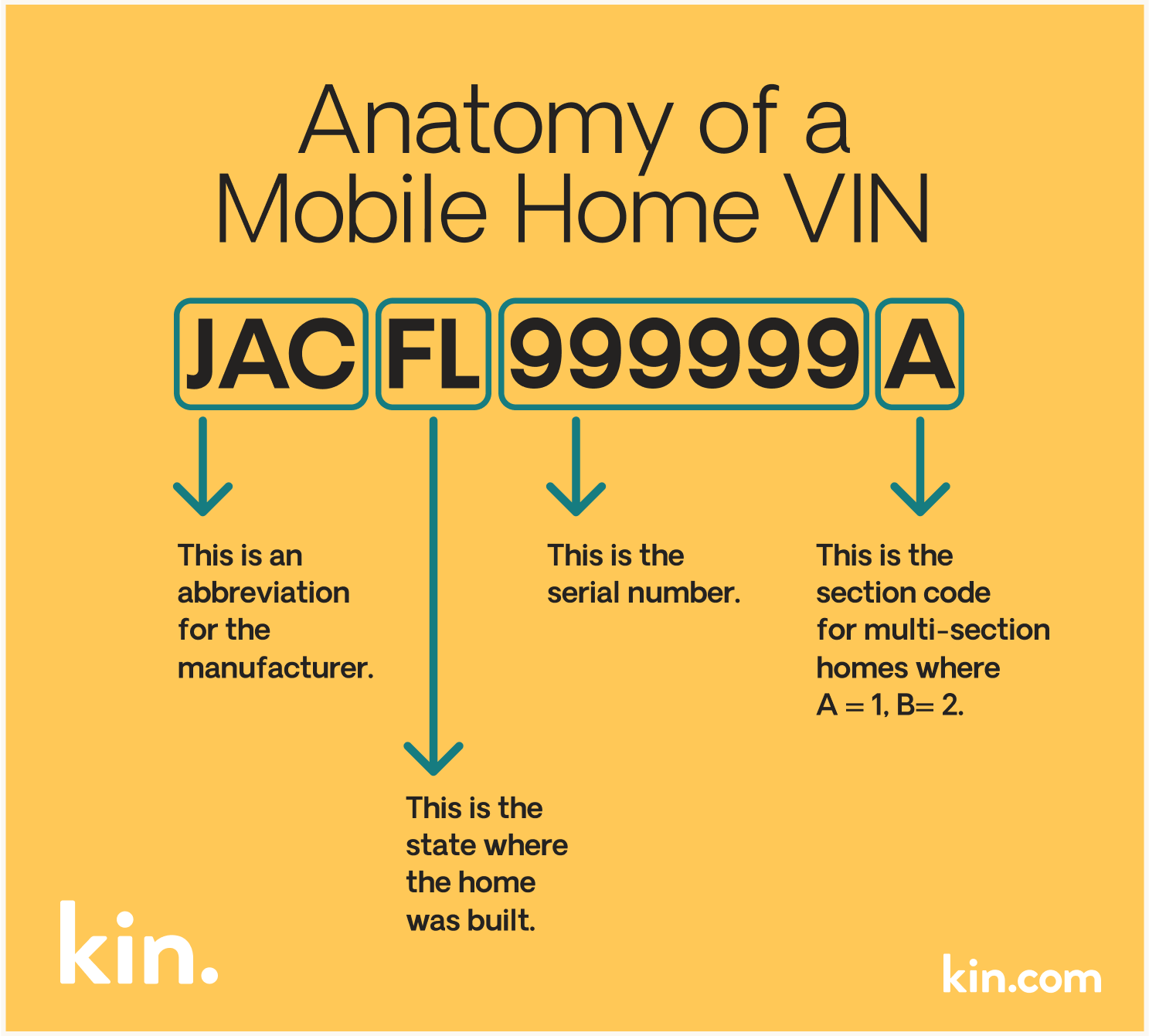
A mobile or manufactured home serial number is an alphanumeric code (string of numbers and letters) specific to the property. It indicates key information like:
-
The manufacturer: The first part of a mobile home serial number is an abbreviation (typically three letters) that represents the manufacturer that made the home.
-
The state: The next two letters are the abbreviation code for the state where the mobile home was built.
-
Serial number: The next string of numbers is your home’s unique identifier. No two mobile homes will have the same serial number.
-
Section code: This letter signifies whether your home has more than one section, as well as where the data plate is located within the home. Single-wide homes with only one section don’t have a section code; multi-section homes (e.g., double wides and triple wides) use letters A, B, etc. to designate various sections.
The VIN on your mobile home should match the VIN listed on the ownership title. If you have more than one section, you most likely have a VIN and title for each section of your home.
Pro tip: According to the U.S Department of Housing and Urban Development (HUD), the serial number and VIN are “one and the same” in some states, but in others, these might be two separate numbers. That said, you can typically use them interchangeably for financing, selling, and insurance.
How to find your mobile home VIN or serial number
Your mobile home’s VIN or serial number should be located in two key places: one located inside on the data plate, and one stamped on the outside steel frame.
Mobile home data plate search
The easiest way to find your mobile home’s serial number is to search for the data plate. As HUD explains it, the data plate “is a paper label affixed inside the home and is the size of a standard sheet of paper (8 ½” x 11”).” Typically, this piece of paper is laminated to prevent it from getting damaged.
While the location of the data plate varies, you can usually find it:
-
Inside a kitchen cabinet
-
Under the kitchen sink
-
On the door of a bedroom closet or HVAC system closet
-
On the electric panel
The data plate contains more than just your mobile home’s VIN. Use this important document to find:
-
The name and address of the home’s manufacturing plant
-
A list of factory-installed equipment
-
A list of certification label numbers affixed to each transportable section of the home
-
Maps of the United States detailing the wind zone, snow load, and roof load of the home
Mobile home steel chassis
Despite the importance of the data plate, it’s possible that, through the years, the piece of paper has been lost or damaged. Fortunately, that’s not the only place you can find the serial number. The VIN should also be stamped on the chassis (meaning the steel frame).
If your mobile home has a skirt around it, finding the steel chassis can be tricky. Start by looking along the steel beam that runs parallel to the front of the home — this is where the triangular tongue beam was attached during transport, and it's typically the easiest spot to find the VIN. Check both the right and left sides. For other locations, you may need to remove some skirting. The VIN characters are at least three-eighths of an inch tall, so look for stamped letters and numbers of that size.
Remember, if you have a double- or triple-wide mobile home, you’ll likely need to find multiple VINs.
How to find the HUD tag
On June 15, 1976, HUD established guidelines for manufactured homes. Any homes built after that date were to include a HUD tag, which confirms the home was built in accordance with the HUD’s Manufactured Home Construction and Safety Standards.
The HUD tag, also called a certification label, is a red aluminum plate, approximately 2 by 4 inches and 0.32 inches thick, permanently affixed to the exterior of the mobile home, typically on the rear. On it, you’ll find a three-letter code that identifies the in-plant primary inspection agency that inspected your mobile home. A six-digit serial number follows.
Like the serial number, a HUD tag is generally required for financing, selling, and insuring a mobile home.
Mobile home data plate vs. HUD tag
|
Data plate |
HUD tag |
|
|
Location |
Inside (usually in closets or cabinets) and stamped on steel frame |
Exterior of manufactured home, usually the rear |
|
Material |
Paper, usually laminated |
Small rectangular aluminum plate |
|
Information provided |
VIN/serial number, maps, factory-installed equipment, etc. |
Inspection agency and unique six-digit serial number |
Manufactured vs. mobile home
The terms manufactured home and mobile home are often used interchangeably. The only real difference between the two is when they were built; homes built before June 15, 1976 are mobile homes, and homes built after are manufactured homes.
What to do if your serial number is missing
Even if your data plate is missing, you should be able to find your serial number stamped onto the steel frame of your mobile home. However, you may need your data plate to sell or insure your mobile home.
If you simply need to confirm the serial number (but you can’t find the data plate and the stamped number has rusted or is inaccessible), you aren’t out of options. Here’s what to do.
-
Check your paperwork: Review any titles, bills of sale, or previous insurance policies to see if there’s a record of the serial number.
-
Contact the manufacturer: Assuming the manufacturer is still in business, it may have records based on the original owner’s name and address.
-
Contact state agencies: Reach out to your state’s Manufactured Housing Department. In some cases, they hold the primary titling records and may be able to provide the information you need.
-
Look for local tax records: Your county tax assessor may have recorded the VIN/serial number for tax purposes.
What to do if your data plate is missing
Before selling your mobile home, you may need to replace the missing data plate, even if you know the serial number. According to HUD, you can potentially replace your data plate by contacting the In-Plant Primary Inspection Agency or the manufacturer.
Alternatively, you can apply for a copy of your data plate with the Institute for Building Technology and Safety (IBTS) if your home is HUD-compliant. Technically, the replacement isn’t a true copy. Instead, it’s a performance certificate. But for your purposes, you can use it like the data plate.
The cost is $125. For expedited delivery, it can cost between $150 and $250.
What to do if your HUD tag is missing
If your HUD tag is missing, HUD will not reissue it. Instead, contact IBTS for a HUD tag lookup. They may be able to issue a letter verifying the certification labels originally attached to your home, which gives your insurance company the information they need.
Why you need a serial number for insurance
When obtaining mobile home insurance, you need to know your mobile home serial number. Together with the make and model, insurers use this to verify your home’s age, manufacturer, and construction standards, all of which shape your coverage options and rates.
Notably, it helps the insurer determine if your home qualifies for replacement cost value (RCV) coverage, which pays to rebuild or replace your home at current prices, versus actual cash value (ACV) coverage, which factors in depreciation. Insurers generally view homes built after June 15, 1976 — verifiable through the serial number’s tie to HUD certification — more favorably because they were built to federal safety standards.
If you can’t provide a serial number, an insurer may decline to quote you altogether, or default to ACV coverage.
Frequently asked questions
Can I look up a mobile home serial number online?
While there isn’t a universal online database for mobile home serial numbers (e.g., nothing comparable to Carfax for passenger vehicles), some states have their own databases, such as Texas and Georgia. Otherwise, you can start your search with IBTS for HUD-certified homes.
If you’re trying to quickly cross-reference whether the manufacturer and model year on your paperwork actually match the physical home, you can try a VIN decoder tool. These aren’t official title searches and can’t tell you anything about ownership history, but they could be useful for catching discrepancies when purchasing a used mobile home.
Is the serial number the same as the HUD tag number?
The serial number or VIN of a mobile home is not the same as the HUD tag number. The HUD tag is the certification label, acknowledging the home was constructed in compliance with federal safety codes. The serial number, or VIN, is a mobile home’s unique identifier and is found on the data plate (and stamped on the steel frame).
How many digits is a mobile home VIN?
Unlike vehicles, which have standard 17-digit vehicle identification numbers, a mobile home’s VIN can vary in length — it depends on the manufacturer and when it was built.
What if my home was built before 1976?
Homes built before 1976 do not have HUD tags. These tags certify that a home was built with specific federal safety standards in mind. Older homes still have serial numbers and data plates, but it may be more challenging to obtain insurance for them.
