Home Insurance in Virginia
Protect your home with top-rated coverage that could save you over $1,000 every year.*
Protect your home with top-rated coverage that could save you over $1,000 every year.*

Whether you do it yourself online or speak with one of our friendly representatives over the phone, Kin makes it easy to find coverage.


Property info

Customize your quote

Get covered

Tell us about your home.
Answer a few basic questions and we’ll generate your home insurance quote in minutes.

Personalize your policy.
Customize your coverages, limits, and deductibles to get the protection you need.

Get covered.
Review your quote and sign your application online. Any questions? Our licensed agents are here to help.
The average cost of home insurance has increased to $1,332 per year in Virginia, but you can save money by protecting your home, avoiding damage, and selecting sustainable options.
Home security - for installing security and fire alarms.
Wind mitigation - the more wind-proof your home, the better.
Water detection - because no one wants a flooded home.
Claims-free - for keeping your home safe over the years.
Electronic policy - for reducing your carbon footprint by saving some paper.
You get more than coverage — you get a team that follows through.
We reach out before, during, and after major weather events to make sure you’re okay — and to assist if you need to file a claim.
Easily file a claim over the phone with a member of our support team or online in your Customer Portal.
Licensed Kin agents are easy to reach and ready to listen. Contact us via email, phone, or live chat.
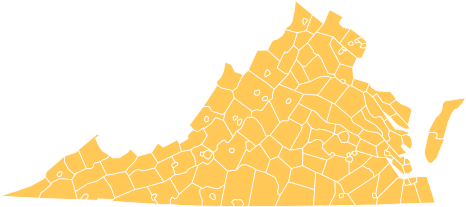
We help Virginians find coverage across the entire Commonwealth!
We sell policies in every county in Virginia, including in these major cities:
Most standard Virginia homeowners insurance policies do not cover termite damage. Insurers consider termites and other pests a preventable maintenance issue, rather than a sudden or accidental loss. As the homeowner, you are expected to manage regular inspections, moisture control, and, if needed, a termite control contract with an exterminator.
Virginia Senate Bill 402 is a new law designed to prevent homeowners from losing coverage solely because of the age of their roof. Under this legislation, insurers generally can’t cancel or nonrenew a policy based on the age of the roof. However, if an aging roof is in poor condition or shows visible damage, your insurer may require an inspection or documentation to confirm that the roof is still in good condition.
Virginia law does not require homeowners to carry flood insurance. Still, it can be a wise investment, especially if you live in the state’s coastal regions. In some cases, if a home is in a high-risk flood zone, your mortgage lender may require flood insurance. Note that even small bodies of water, such as streams or drainage ditches, can overflow, cause flooding, and result in extensive property damage.
Virginia hurricane deductibles are typically a separate, percentage-based deductible that applies if a named hurricane or tropical storm causes damage to your home. Instead of paying a flat dollar amount, such as $1,000, a hurricane deductible is likely to be a percentage of your dwelling coverage. A 2% hurricane deductible on a $300,000 policy, for example, would mean you must pay $6,000 out of pocket before your insurance kicks in after a hurricane.
The Virginia Property Insurance Association (VPIA) is Virginia’s insurer of last resort for homeowners who cannot get coverage in the standard insurance market because their home is considered too high-risk, such as those in coastal regions where the likelihood of hurricanes and other severe weather events is high. VPIA policies may be more limited than standard homeowners insurance, requiring supplementary coverage to ensure full protection.