Save Up To 20% When Bundling Home* & Auto Insurance
Keep your insurance in one place for extra savings.
Keep your insurance in one place for extra savings.

You could save up to 20% when you bundle your policies with Kin.


Home & Auto Info

Customize your quote

Get covered

Tell us about your home & automobile.
Answer a few basic questions and we’ll generate your quote in minutes.

Personalize your policy.
Speak with one of our licensed agents about what you could save.

Get covered.
Review your quote and sign your application online.
Bundling your home and auto insurance with Kin
Accident-free
Autopay
Defensive driver
Early bird
ePolicy
Good payer
Homeowner
Loyalty
Multicar
Payment plan
Vehicle equipment (selected safety features)
From a streamlined experience to serious savings, bundling makes life easier.
You can save up to 20% when you bundle your policies with Kin.*
Two policies, one portal. Manage everything in one, easy-to-access place.
Licensed Kin agents are easy to reach and ready to listen. Contact us via email, phone, or live chat.
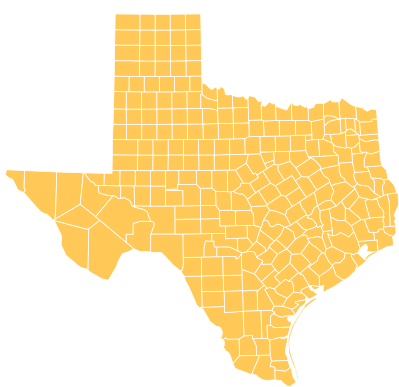
We help Texans find coverage across the entire Lone Star State, including in these major cities.
For minimum, state-mandated coverages, the average cost of car insurance in Texas is $399 per year for drivers with “excellent” credit scores, $641 per year for drivers with “fair” credit scores, and $904 per year for drivers with “poor” credit scores according to the latest data available from the Consumer Federation of America. However, premiums for recommended coverage levels are significantly higher, including the driver's location within the state of Texas.
Insurance companies set your rate by estimating how risky you are to insure. They look primarily at your age, driving history, and where you live. They also check your credit score and specific details about your car, such as how safe it is and how much it costs to fix. In some parts of Texas, drivers with comprehensive coverage may pay higher-than-average rates due to the high risk of extreme weather events, such as hail, flooding, and hurricanes, that can damage vehicles.
At Kin, a basic policy covers liability, which pays for injuries or damage you cause to other people. If you get 'full coverage,' it also includes collision (to fix your car after a crash) and comprehensive (for things like theft, fire, hail, or flood damage). You can also add coverage for medical bills or protection in case you get hit by an uninsured driver.
At Kin, as at most insurers, your car insurance doesn't cover normal wear and tear, mechanical breakdowns, or routine maintenance (like oil changes). It also won't pay for personal items stolen from your car — that’s usually covered by your home or renters insurance. Finally, you aren't covered if you use your car for business, like delivering food or driving for a rideshare app, unless you add special coverage for it.
Experts suggest buying enough liability coverage to match your net worth (like your savings and home value) so you aren't wiped out by a lawsuit. State minimums might be legal, but they usually aren't enough to pay for a bad accident, meaning you'd have to pay the rest out of pocket. Also, if you have a loan or lease on your car, the lender will likely force you to buy full coverage (collision and comprehensive).
Yes, car insurance is legally required in Texas for any vehicle with four or more wheels. In fact, you must show proof of insurance coverage before you can register a car, renew your registration, or pass your annual state vehicle inspection.
Texas requires drivers to carry "30/60/25" liability coverage. This includes at least $30,000 for injuries per person, up to $60,000 per accident, and $25,000 for property damage. Unlike some states, this minimum coverage only pays for injuries and damage you cause to others; it does not cover your own medical bills or vehicle repairs.
Beyond the basic state requirements, Texas drivers should strongly consider Uninsured/Underinsured Motorist (UM/UIM) coverage, which protects you if you are hit by a driver who has no insurance or not enough to pay for your damages. You should also consider Personal Injury Protection (PIP) or Medical Payments (MedPay) to cover your own medical bills, as Texas is an "at-fault" state where standard liability won't pay for your own injuries. Finally, Gap Insurance is crucial if you finance your vehicle, ensuring you aren't left paying a loan balance on a totaled car.